Although life in Italy may be difficult these days because of the economic situation, there are still some very basic factors that keep this sunny country sweet.
In Italy.....
1. You can still get the best espresso coffee and croissant for total Euro 1.80 or $ 2.45. No Starbucks or Peets or Coffee Bean can compare to those offered by my neighborhood caffè bar and at that price!!
2. In my
Showing posts with label Italian food. Show all posts
Showing posts with label Italian food. Show all posts
Saturday, November 19, 2011

Monday, November 29, 2010
Falanghina
 Pronunciation: fa-lahn-GEE-na (That's a hard "G.")
This is probably the white wine that was most ubiquitous in my Ischia-Napoli world. It's what came in carafes as the house wines, and it's what could also be found in an average to fancy bottle. A cold condensation on a hand-painted pitcher of Falanghina next to a hot pizza, screaming of basil, milk, and tomatoes would melt that Summer sun right out the sky.
Living most of the time in Ischia, Falanghina was still the go-to white. I say this because Biancolella and Forastera are the varieties indigenous to the island, but the island just isn't that big. Not big enough to quench the thirsty, fish-eating masses anyway.
So here we are back in Texas, and my heart calls out for the real thing. My DoBianchi brought home a shiny white ball of Mozzarella di Bufala and a bottle of Cantine del Taburno Falanghina, but, alas, I am still searching for an unoaked/unmalo-ed/non-acidified yet certified stateside version. I won't give up. I can survive on the fumes of my memories just a little longer.
Until I find it, don't cry for me Falanghina, the truth is you never left me.
Text below adapted from: Del Canuto, Francesco et al., Il vino italiano, vitigni, enografia, e grastronomia regionale, Associazione Italiana Sommeliers (Bertani & C.), Milano, 2010 (2002), fourth edition.

Alternative Names: Fallanghina, Falanghina verace, Uva Falerna, Falerno Veronese, and Biancuzita
Historical Notes: This grape variety has ancient origins and was probably cultivated in Sannio going back to the Roman Era. The first documentation of this variety, however, is from 1825, even though it was frequently confused with other grapes.
Production Zone: Falanghina is most widely produced in Campania. It finds its best expression in the area of Falerno del Massico, the island of Procida, Campi Flegrei, and Sannio.
Characteristics: average to small leaves that are smooth and wedge-shaped and usually have 3 lobes, sometimes 5, with green veins and red streaks; The clusters are compact and cylindrical with one small wing. The berries are round and covered in bloom. The skins are thick with a yellow-gray hue.
Ripening: second half of September
Productivity: average
Vigor: good
Wine made from Falanghina has a straw-yellow color, tending toward golden with an intense and fruity nose. It usually has softer acid and a pleasant, persistent finish.
Saturday, November 13, 2010
Aversa DOC
 Aversa is one of the two places in Italy most famous for its Mozzarella di Bufala (Caserta is the other). And don't I know it. I ate my weight in the precious stuff during my time living between Ischia and Naples. There is absolutely nothing that can compare to a so-fresh-it's-warm ball of true water buffalo mozzarella oozing with milk. The milk of said beast is particularly high in fat, which means it is particularly delicious. No imitator can be tolerated after being ruined on the real thing. (Don't even try, upscale grocery store!)
Neapolitans are so proud (SO. PROUD.) to call this one of their many regional gifts to the world. A slice the size of a ham steak is but a snack, incapable of adding girth to the thighs of anyone and in fact, is nothing less than a nutritional miracle. Just ask any mamma italiana.
 "A taste is worth more than 1000 words." Sure is.
 Mozzarella in Carrozza (mozzarella in a carriage) is the name of a dish prepared like this: put a generous slice of fresh mozzarella between two slices of bread, dip it in flour and egg, then pan-fry. One can only imagine the crunch which gives way to the soft, fragrant and gooey interior. Mamma mia! And it just begs for a simple glass of high-acid, Aversa DOC. Enjoy.
Text below adapted from: Del Canuto, Francesco et al., Il vino italiano, panorama vitivinicolo attraverso le denominazioni di origine, Associazione Italiana Sommeliers (Bertani & C.), Milano, 2010 (2002), fourth edition.
Recognized as DOC 8/12/93
Production Zone: includes the townships of Aversa, Carinaro, Casal di Principe, Casaluce, Casapesanna, Cesa, Frignano, Gricignano di Aversa, Lusciano, Orta di Atella, Parete, San Cipriano d'Aversa, San Marcellino, Sant'Arpino, Succivo, Teverola, Trentola-Ducenta, Villa di Briano e Villa Literno, all in the province of Caserta; Giuliano in Campania, Qualiano e Sant'Antimo in the province of Naples
Yield: max 12 tons per hectare
Grape Variety: Asprinio, min 85%
Minimum alcohol: 10.5%
Aging potential: on average, 1 year
Other types
Spumante: made with 100% Asprinio with a minimum alcohol of 11%. In the case of vineyards trained using the "alberata aversana" style of vine training (an environmental and cultural contribution of the appellation), the yield cannot exceed 4 kilograms of grapes/sq meter of wall and 240 kg of grapes per plant, with a maximum number 50 plants per hectare
Alberata or Vigneti ad alberata: wines made in the Aversa appellation using grapes obtained from vineyards planted using the alberata aversana method must include Alberata or Vigneti ad Alberata on the label.
Also, Asprinio can precede the name of the appellation on the label, for example, Asprinio di Aversa DOC
The production area, which includes 22 townships in what used to be Liburia,** is identified by its Asprinio vineyards trained to poplar trees, which act as stakes or supports for the vines. This method of pruning creates large green walls that can reach up to 15 meters [roughly 45 ft] in height. This white grape variety, by name, reveals its distinction among other grapes--its intense acidity. If great care isn't taken in the vineyards and the winery, the acidity can become too aggressive.
The problem with most producers of this wine is that they source their grapes from growers and are therefore unable to intervene in the vineyards to help improve the quality of the end product.
This unique style vine training is of Etruscan origin. Although it is striking to behold, pruning is extremely difficult at the tops of the plants.
One producer of note is using canopy pruning, with more plants per hectare and lower grape yields. The result is a wine that, perhaps, doesn't reflect the tipicity of the grape variety in that the wine is less acidic. (In the debate over typicity vs. defect we risk a never-ending argument...) Without a doubt though, the wine is more enjoyable because it's softer. It is in this vein that the producer is aging some if his wine in 7, 10, and 15 hL oak barrels for 1 year. [Here we go again with the barriques!]
Although only humble results are obtained using the Charmat method, sparkling wine made from Asprinio is delightful as an aperitif. Still wine from the appellation pairs well with seafood salad, fish dishes, pizzas, calzones, and the famous mozzarella in carozza. [See intro]
Asprinio is also used in the production of passito (dried-grape wine) in the appellation Terre al Volturno IGT.
**Liburia is the ancient name for the area known today as Terra di Lavoro (Southern Lazio and Northern Campania). The Latin name is derived from the word Leborini who were an ancient tribe that inhabited the area. The modern name, Terra di Lavoro means "land of work."
Friday, May 1, 2009
My Guest Blogger: DoBianchi's Take on Fresh Pasta
To complete my pasta series with style (you can see part 1 here and part 2 here) I enlisted the help of my own resident smarty pants, Jeremy Parzen. In addition to having spent a number of years in Northern Italy, he has a doctorate in Italian Literature. His authoritative voice on all things pasta and Petrachan will impress you for sure...worked for me!
Take it away, DoBianchi...
I cannot conceal that when Tracie B asked me to guest blog at My Life Italian, I was thrilled. I mean, after all, who wouldn't be honored to contribute to the blog of the woman who wrote a line I wish I wrote, about happy vines she saw in Ischia: If I were a vine, I would grow here. Her innate gifts as a writer, her humor, honesty, and honed palate, and — above all — her insights and perspective into the "garden of Europe" — the bel paease — the fair country are what made me fall for her in the first place. The title of her blog alone still makes me melt. Hey, Tracie B, you had me at hello… Or should I say, ciao?
One of the fun things about our relationship and our shared Italophilia is how she lived in Southern Italy, while I lived in the North. When we talk together in Italian, it's a veritable Tower of Babel: she, the belle from Orange, Texas speaks with a rich, musical Neapolitan accent, and I, from San Diego, speak with a nasaly, sharp Veneto accent!
When she posted the other day about the preference and tradition of "dried pasta," pastasciutta, in Southern Italy, she suggested that I write something about the fresh pasta that prevails in Emilia. So, I wrote to my friend Dindo in Bologna, and asked him to take some photographs of his mother making the fresh pasta that she makes nearly every day.
It's not that people in the North don't eat dried pasta. As a matter of fact, the Emilians are very proud of their Barilla, which is based in their region. But fresh lasagne and tagliatelle reign supreme there, as do a wide variety of stuffed fresh pastas — ravioli, tortelli, tortellini, cappelletti, etc.
Historically, dried pasta has its origins in Southern Italy. In Maestro Martino's 15th-century cookbook The Art of Cooking (which I translated for University of California Press, 2005), he includes a recipe for a dried pasta that resemble today's fusilli. He calls it "Sicilian macaroni" and instructs the reader to dry it in the sun, adding that it can last for up to three years. It's very likely that the warmer temperatures of the South and the ventilation provided by the sea are among the factors that would make Gragnano near Naples the unrivalled center for the production of dried pasta by the mid-18th century.
In landlocked Emilia, humidity and colder temperatures are factors in a unique macroclimate that gives us a variety of culinary wonders, like Parmigiano Reggiano. Did you know, for example, that you can replicate the methods for making Parmigiano Reggiano elsewhere in the world, but it only gets that unique texture and consistency when made in the foggy, damp provinces of Parma and Reggio Emilia (where the smell of pig poop is ubiquitous)?
There are other reasons why the Emilians still favor fresh pasta but the geography and climate alone are a big part of why fresh pasta prevails in the North.
Here is Signora Corradino's method for making garganelli, with ridges of course!

After you've rolled the pasta out, you cut it into squares.

Then you roll those around a wooden rod (this is similar to Maestro Martino's technique for Sicilian macaroni).
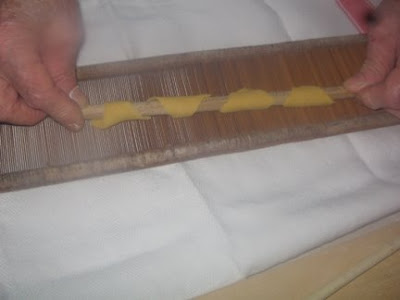
Then you make the ridges — so important in order for the sauce to penetrate the pasta — using a specially made pasta loom.
Take it away, DoBianchi...
I cannot conceal that when Tracie B asked me to guest blog at My Life Italian, I was thrilled. I mean, after all, who wouldn't be honored to contribute to the blog of the woman who wrote a line I wish I wrote, about happy vines she saw in Ischia: If I were a vine, I would grow here. Her innate gifts as a writer, her humor, honesty, and honed palate, and — above all — her insights and perspective into the "garden of Europe" — the bel paease — the fair country are what made me fall for her in the first place. The title of her blog alone still makes me melt. Hey, Tracie B, you had me at hello… Or should I say, ciao?
One of the fun things about our relationship and our shared Italophilia is how she lived in Southern Italy, while I lived in the North. When we talk together in Italian, it's a veritable Tower of Babel: she, the belle from Orange, Texas speaks with a rich, musical Neapolitan accent, and I, from San Diego, speak with a nasaly, sharp Veneto accent!
When she posted the other day about the preference and tradition of "dried pasta," pastasciutta, in Southern Italy, she suggested that I write something about the fresh pasta that prevails in Emilia. So, I wrote to my friend Dindo in Bologna, and asked him to take some photographs of his mother making the fresh pasta that she makes nearly every day.
It's not that people in the North don't eat dried pasta. As a matter of fact, the Emilians are very proud of their Barilla, which is based in their region. But fresh lasagne and tagliatelle reign supreme there, as do a wide variety of stuffed fresh pastas — ravioli, tortelli, tortellini, cappelletti, etc.
Historically, dried pasta has its origins in Southern Italy. In Maestro Martino's 15th-century cookbook The Art of Cooking (which I translated for University of California Press, 2005), he includes a recipe for a dried pasta that resemble today's fusilli. He calls it "Sicilian macaroni" and instructs the reader to dry it in the sun, adding that it can last for up to three years. It's very likely that the warmer temperatures of the South and the ventilation provided by the sea are among the factors that would make Gragnano near Naples the unrivalled center for the production of dried pasta by the mid-18th century.
In landlocked Emilia, humidity and colder temperatures are factors in a unique macroclimate that gives us a variety of culinary wonders, like Parmigiano Reggiano. Did you know, for example, that you can replicate the methods for making Parmigiano Reggiano elsewhere in the world, but it only gets that unique texture and consistency when made in the foggy, damp provinces of Parma and Reggio Emilia (where the smell of pig poop is ubiquitous)?
There are other reasons why the Emilians still favor fresh pasta but the geography and climate alone are a big part of why fresh pasta prevails in the North.
Here is Signora Corradino's method for making garganelli, with ridges of course!

After you've rolled the pasta out, you cut it into squares.

Then you roll those around a wooden rod (this is similar to Maestro Martino's technique for Sicilian macaroni).

Then you make the ridges — so important in order for the sauce to penetrate the pasta — using a specially made pasta loom.
Saturday, April 18, 2009
Pastasciutta Part 2: La Cottura

Click here for Part 1.
La Cottura in Italian refers to "how you cook the pasta." Jeremy (my very own highly-paid Italian language expert) explained to me that there is no direct translation, when I asked him if there were another way to define this word without using an entire English phrase.
But there is no direct or "slavish" translation for this second important element in making a great plate of pasta. Much more simple, at the same time much easier to err, than it would seem.
The simplicity (and difficulty) in all of this is twofold.
1. Salting the water
2. Duration of boiling
For the first, many a cookbook would have you egregiously underseason your water. I use the word "season" because how you flavor the water translates to flavor enhancement of the pasta itself. In Italy, we can eat a fantastic primo piatto, but recreating that glory once home can leave even the best home cook scratching her head, wondering why she can't get that same intangible...umph.
One thing that I have seen over and over in my years in Italy is a generous flow of salt into the boiling pot. Taste your water; it should be just a bit less salty than the sea. This may seem like an exaggeration but I promise it will take the pasta itself from being a neutral vessel for the exaltation of your best sauce to a supporting role that takes the whole show over the top.

Second, please don't overcook your pasta. I said PLEASE DO NOT NOT NOT OVERCOOK THE PASTA! Did you hear me? Chewing on slightly undercooked pasta is preferable to the awful sensation of a rigatone that gives up too easily under the pressure of your teeth.
Besides the flavor of your sauce, you should really be enjoying a well seasoned spaghetto with the pleasant tactile sensation of pasta that is perfectly al dente. You want to feel, taste, and smell its presence underlining the fabulosity of your perfect ragu'.
To achieve this effortlessly, read the cooking time on your box of high quality dried pasta (remember lesson 1?) and drain it about 2 minutes short. There will be carry-over cooking as well as a bit more time in the pan with the condiment. (Please tell me that you stir your pasta in the pan with the sauce! Also important--must meld.)
Tell your guests to sit down and dig in when the plate hits the table because, honey, zee pasta waits-a for a-nobody!
Subscribe to:
Posts (Atom)